
ABOUT US
COMMUNITY


COMMUNITIY>Press
Press

Official Press Releases of BICHEDAM
260409 Saengmaeksan-gagambang Demonstrates Significant Improvement in Arterial Stiffness, Highlighting Its Potential as a Novel
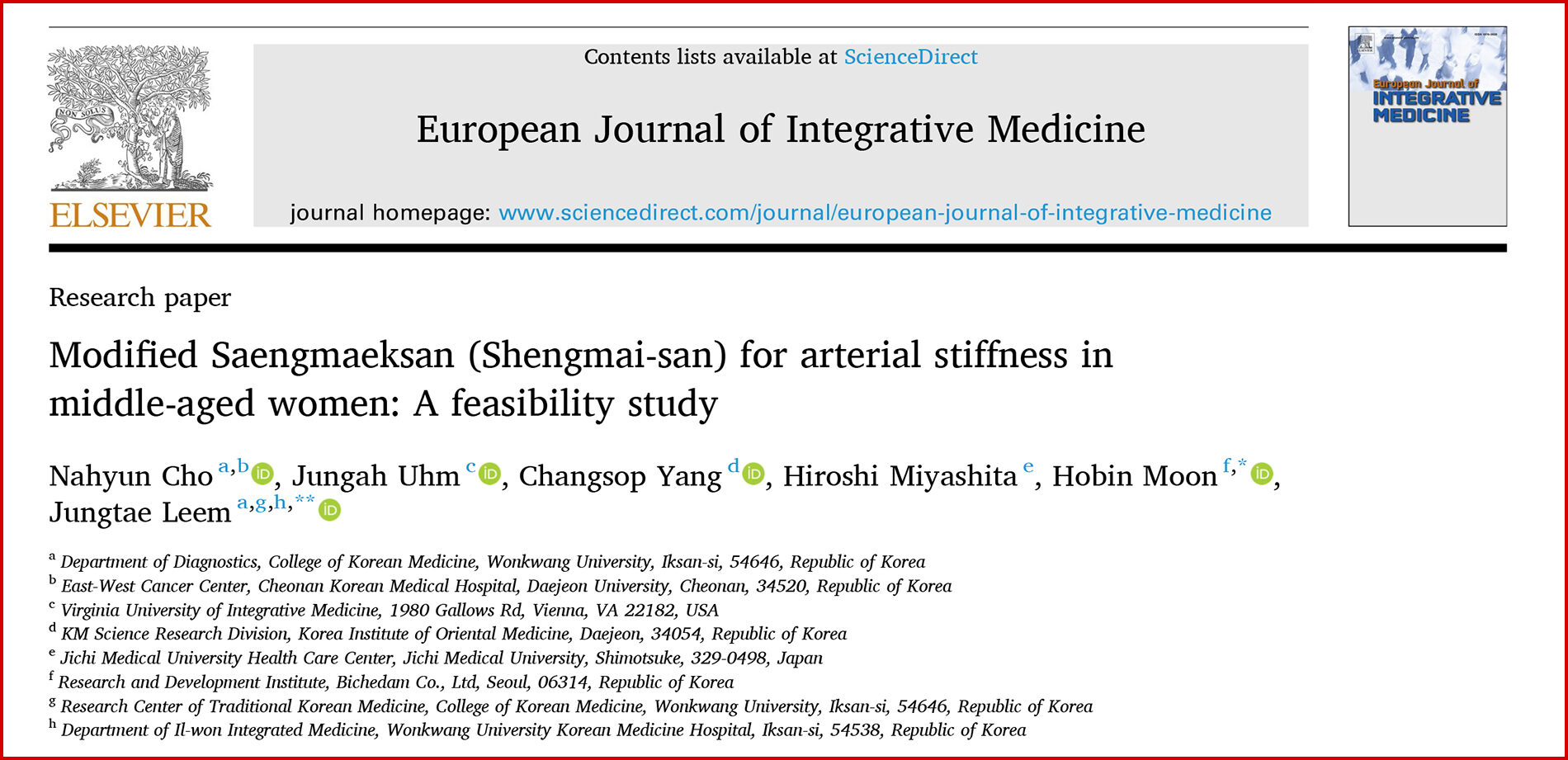

[The Korean Medicine Newspaper] Clinical research demonstrating that Modified Saengmaeksan (BCD101) has positive effects on improving arterial stiffness in middle-aged women has been published in an international scientific journal.
The study confirmed reductions in vascular age, improvements in blood pressure parameters, high medication adherence, and a favorable safety profile, highlighting the clinical potential of herbal medicine-based strategies for the prevention of cardiovascular diseases.
As an outcome of the Public Resource Development Project for Korean Medicine Treatment Technologies, the study is also considered significant for establishing a foundation for the future development of novel herbal pharmaceuticals.
The research, titled “Modified Saengmaeksan for Arterial Stiffness in Middle-Aged Women: A Feasibility Study,” was conducted jointly by Professor Jeong-Tae Lim’s research team from the Department of Diagnostics, College of Korean Medicine, Wonkwang University, and Bichedam Co., Ltd.
The paper was published in the SCIE-indexed journal, European Journal of Integrative Medicine.
The study represents one of the major outcomes of the Public Resource Development Project for Korean Medicine Treatment Technologies (HI16C0275), an initiative led by the National Institute for Korean Medicine Development (NIKOM). The project aims to transform the clinical experience and prescription technologies accumulated by individual Korean medicine clinics into institutionalized research and establish them as shared resources for the Korean medicine community.
### Feasibility Study Targeting Menopausal Arterial Stiffness in 30 Middle-Aged Women
Based on a herbal prescription that has long been used in clinical practice, the research team developed a standardized formulation, BCD101, and evaluated its efficacy through a scientific clinical study. The research serves as an example of both the modern reinterpretation of a traditional herbal prescription and its potential for industrial application.
The study was designed as a single-arm, prospective observational feasibility study conducted at Bichedam Korean Medicine Clinic, with the objective of assessing the practical applicability of BCD101 in a real-world clinical setting.
A total of 30 middle-aged women, ranging in age from 43 to 67 years, received Modified Saengmaeksan for four weeks, during which changes in vascular health indicators were evaluated. The study is particularly noteworthy for focusing on arterial stiffness, which increases rapidly after menopause.
The evaluation included vascular age measured using the Second Derivative of the Photoplethysmogram (SDPTG), the Augmentation Index (AIx), blood pressure-related parameters, heart rate variability (HRV), and the Measure Yourself Medical Outcome Profile (MYMOP). To ensure safety, laboratory blood tests, including liver function assessments, were also performed throughout the study.

Significant Improvements in Augmentation Index and Blood Pressure After Four Weeks of Treatment
The study demonstrated positive changes across multiple vascular health indicators following four weeks of treatment with Modified Saengmaeksan (BCD101).
One of the most notable findings was a mean reduction of 15.9 years in vascular age, as measured using the Second Derivative of the Photoplethysmogram (SDPTG). This change was highly statistically significant (p < 0.001), suggesting a meaningful improvement in vascular elasticity.
In addition, the Augmentation Index (AIx)—a key indicator of arterial stiffness—showed a significant reduction. Improvements were also observed in major blood pressure parameters, including systolic blood pressure, diastolic blood pressure, and central aortic blood pressure.
Patient-reported outcomes, assessed using the Measure Yourself Medical Outcome Profile (MYMOP), also demonstrated statistically significant improvement, indicating meaningful clinical benefits perceived by the participants.
“Arterial Stiffness Is a Key Cardiovascular Risk Factor”—Study Suggests an Expanded Role for Korean Medicine
Dr. Na-Hyun Jo, the study’s first author and a doctoral candidate in the Department of Diagnostics, College of Korean Medicine, Wonkwang University, stated:
> “Arterial stiffness is a major risk factor for cardiovascular diseases such as myocardial infarction and stroke, and it increases rapidly in women after menopause. This study suggests that herbal medicine may contribute not only to symptom relief but also to improvements in vascular function, providing evidence for an expanded role of Korean medicine in the prevention of cardiovascular diseases.”
Another noteworthy outcome of the study was its excellent safety profile and high treatment adherence. All 30 participants completed the study without any dropouts, and the average medication adherence rate reached 94.4%, indicating excellent compliance.
Furthermore, safety evaluations, including liver function tests, revealed no serious adverse events, supporting the clinical applicability of Modified Saengmaeksan (BCD101).
Professor Jeong-Tae Lim, co-corresponding author of the study, commented:
“Although this was a single-arm pilot study, we successfully achieved complete data collection and a high level of participant adherence.These findings support the feasibility of conducting larger-scale clinical trials in the future.”
<img style=”max-width: 900px;” src=”https://bichedam.co.kr/wp-content/uploads/kboard_attached/1/202605/6a0fa75c311852602627.jpg” alt=”” />
Multiple Mechanisms, Including Rho-Kinase Inhibition, May Contribute to Improved Vascular Function
The research team also proposed several potential mechanisms underlying the therapeutic effects of Modified Saengmaeksan (BCD101).
Ho-Bin Moon, CEO of Bichedam Co., Ltd., stated:
> “Modified Saengmaeksan is expected to promote vascular health through multiple mechanisms, including improvement of endothelial function, reduction of oxidative stress, and suppression of inflammatory responses.”
The researchers further suggested that the combined actions of the herbal components—including inhibition of the Rho-kinase signaling pathway, promotion of vasodilation, and attenuation of vascular remodeling—may collectively contribute to the observed improvements in vascular function.
Unlike conventional Western medicine, which often targets a single molecular pathway, these findings reflect the multi-target therapeutic characteristics of herbal medicine, where multiple biological pathways may work synergistically to improve vascular health.
Soo-Hyun Kwon, Team Leader at the National Institute for Korean Medicine Development (NIKOM) and the project lead for the Public Resource Development Program, commented:
> “The Public Resource Development Project, which began in 2017, has progressed from foundational research to Phase I and Phase II clinical studies and is now advancing toward the regulatory approval process for a novel herbal medicine for cardiovascular disease. As the initial investment in herbal medicine research and development is now yielding tangible outcomes, continued support for R&D will be essential.”
The research team also emphasized that cardiovascular disease accounts for more than 30% of deaths worldwide, highlighting the importance of exploring the preventive potential of herbal medicine.
Given its non-invasive nature and favorable safety profile, herbal medicine may serve as a complementary strategy alongside existing therapies and contribute to the development of a prevention-oriented healthcare system in aging societies.
Professor Jeong-Tae Lim added:
“Although this was a single-arm pilot study, we achieved a high medication adherence rate of 94.4% and complete data collection, supporting the feasibility of conducting larger-scale clinical trials. Moving forward, we plan to conduct randomized controlled trials including a control group to more clearly establish the preventive effects of Modified Saengmaeksan on cardiovascular disease.”
Source : https://www.akomnews.com

© 2025 BICHEDAM. All Rights Reserved.